
Blog › SEA › Google Ads Creatives: How to Build Ads That Actually Convert
Google Ads Creatives: How to Build Ads That Actually Convert
Most Google Ads creatives get ignored. Here's how to write search copy, design display visuals, and structure video ads that move B2B buyers through the funnel, with less waste.
Most Google Ads creatives get ignored. Not because the product is wrong or the budget is too small, because the ad fails to earn attention in the moment the buyer is scanning results.
The creative is the first point of contact between your campaign and your buyer. Get it wrong and no amount of targeting or budget fixes the conversion rate. Get it right and you compound every other part of your Google Ads for SaaS strategy.
This guide covers how to build search ad copy that performs, display visuals that move buyers through the funnel, and how to test creatives so you know what's actually working.
What Are Creatives in Advertising?
Creatives are the ad elements buyers actually see: headlines, descriptions, images, videos, CTAs. They're what triggers a click, or doesn't.
In Google Ads, creatives split into two categories based on campaign type. Each requires a different approach.
The two types of Google Ads creatives
-
Search campaign creatives are text-based. Headlines, descriptions, sitelinks, call assets, structured snippets. The buyer is actively searching, your job is to match their intent precisely.
-
Non-search campaign creatives are visual-first. Display, Demand Gen, Performance Max, video. The buyer isn't searching, you're interrupting their browsing. Visual clarity and message sharpness determine whether they stop or scroll past.
Both types matter for a complete Google Ads for SaaS strategy. They reach buyers at different funnel stages and require fundamentally different creative logic.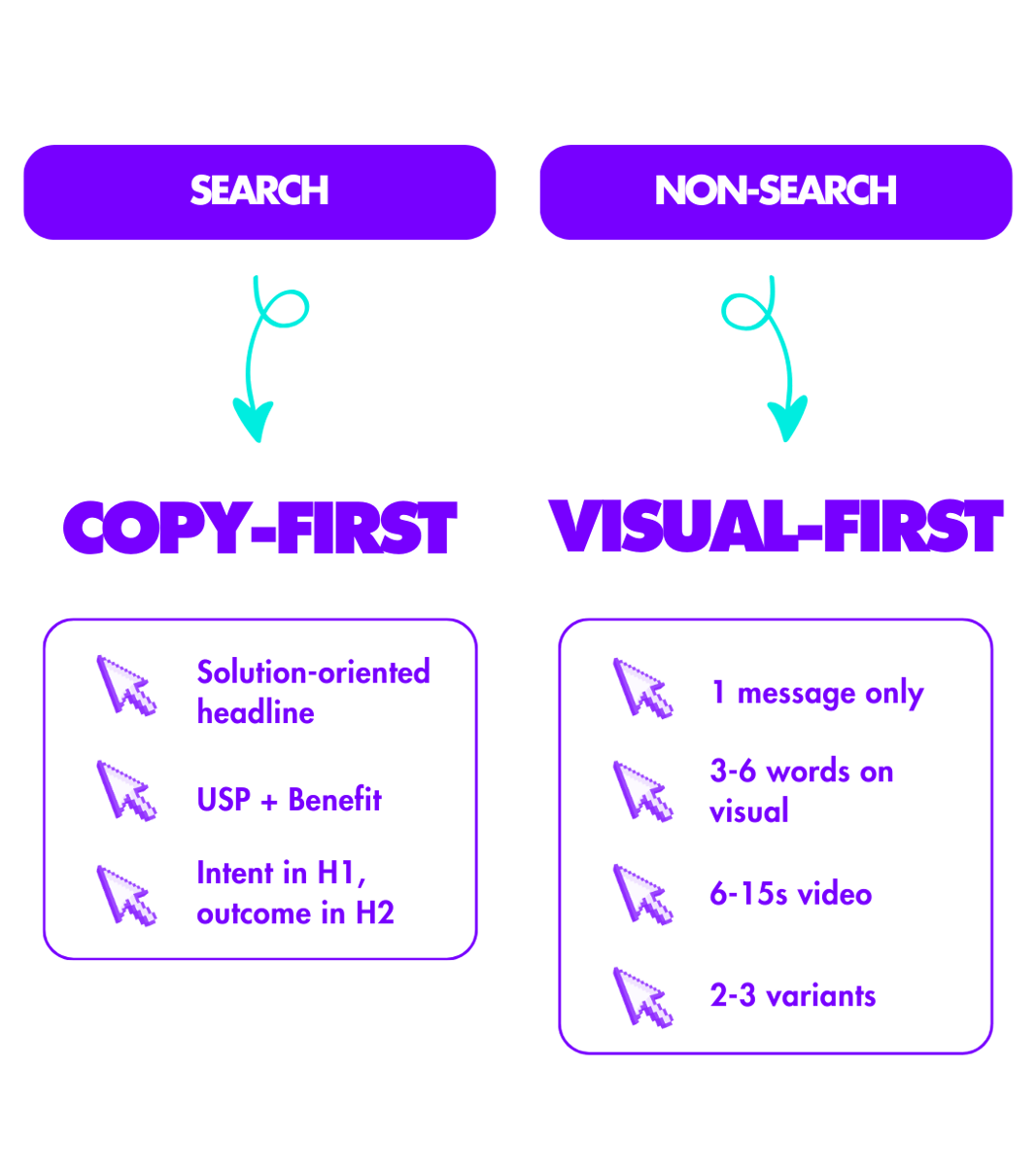
Responsive search ads: how to write search ad copy that converts
Responsive search ads (RSAs) are the standard format for Google Search campaigns. You provide up to 15 headlines and 4 descriptions, Google tests combinations and serves the highest-performing versions automatically.
The quality of your headlines determines everything.
The three headline types that work
Structure your headlines around three angles:
Solution headlines, Name the product, platform, or category. Example: "AI-Powered CRM Software"
USP headlines, State your competitive advantage. Example: "Automate 80% of Your Sales Process"
Benefit headlines, Show the outcome for the buyer. Example: "Save 20 Hours Per Employee Per Month"
Having all three types in your RSA gives Google the raw material to serve the right combination to the right query. Missing one type limits what the algorithm can do with your budget.
Don't pin your headlines
Pinning forces a headline into a fixed position regardless of context. Pinning reduces ad strength and limits Google's ability to optimize, which consistently lowers Quality Score and increases cost per click. Let Google test the combinations. That's the point of a responsive format.
Structured snippets and call assets
Structured snippets surface specific features or use cases beneath your ad. Work with your sales team to understand what your buyers care about most, and use that language, not internal product terminology.
Call assets make your contact details visible directly in the ad, which matters for high-intent searchers who are ready to talk before they even click.
One practical detail: capitalize key words in headlines. "Software Solution for Process Optimization" consistently outperforms "software solution for process optimization" in readability and click-through rate, small change, measurable impact.
Display ad design: visuals that work in non-search campaigns
In Display, Demand Gen, and Performance Max campaigns, the visual carries the message. Two approaches work:
Clean visuals without text overlay, Google adds your headlines automatically. Use strong, uncluttered imagery that communicates your brand without needing text to explain it.
Visuals with one focused message, Add a single bold USP in large text. One line. Example: "Boost conversions with AI-driven email marketing."
What consistently underperforms in display ad design:
- Too much text over the image, Google penalizes this and it becomes unreadable at smaller ad sizes
- Complex or cluttered layouts that compete with the message
- Generic stock photography with no visual connection to the product or audience
Display creatives reach top-of-funnel or retargeting audiences. The message should match where that audience sits in their journey, not pitch a demo to someone who's never heard of you.
Video and retargeting: keep it focused
For Google Video Ads and display retargeting, three creative formats consistently work:
Offer ads, A clear, time-bound deal or trial. Works well for retargeting users who visited your pricing page but didn't convert.
Explanation ads, Short videos that demonstrate what the product does. Effective for mid-funnel audiences who understand the problem but not your solution.
Brand or light ads, Lower pressure, builds familiarity. Useful for top-of-funnel placements where direct response isn't the goal yet.
The common mistake: making these too long or too complex. Retargeting audiences already know you exist. The creative just needs to bring them back, not re-explain everything from scratch.
Google Ads A/B testing: how to validate your creatives
Running ads without testing is spending without learning. Google Ads A/B testing tells you what's actually driving performance, not what looks good in a presentation.
For responsive search ads, the built-in combination testing handles most headline testing automatically. But three things are worth actively testing beyond that:
Landing page alignment, Does the headline promise match what the landing page delivers? Misalignment is the most common conversion killer and the easiest to fix. Test different landing page variants against the same ad copy to isolate where buyers drop off.
CTA variations, "Book a Demo" vs "See It in Action" vs "Get Started Free" can produce significantly different conversion rates depending on audience stage. Test one CTA change at a time to get clean data.
Visual formats in display, Test clean-image formats against text-overlay formats for the same audience. The winner varies by industry and buyer type and is rarely predictable without live data.
One rule that matters: change one variable at a time. Testing multiple elements simultaneously makes it impossible to know what actually moved the result.
Before launching any campaign, run this check:
- Headlines structured around solution, USP, and benefit, no pinning
- Display visuals that work without text explaining them
- CTA specific to funnel stage, not generic
- At least two RSA variants per ad group to enable testing
- All assets compliant with Google's ad policies
For the full campaign framework these creatives plug into, read our SEA strategies guide →
Conclusion
Strong Google Ads creatives aren't creative for the sake of it, they're precise. Search ad copy that matches intent. Display visuals that stop the scroll. Video that respects attention. Testing that tells you what works before you scale.
Every element of your creative either earns attention or wastes budget. Build with that constraint in mind and your Google Ads for SaaS campaigns become significantly easier to optimize and scale.
Want a datasheet or a template to help you build great ad creatives? Click here to get access!
.png?width=1115&height=350&name=Website%20Banner%20(4).png)
Does this sound like you? A conversation is the fastest way forward.
30 minutes. No sales pitch. Just a straight conversation about where you are and where you want to go.